 AnavClouds Analytics.ai
4 days ago in Business Services
AnavClouds Analytics.ai
4 days ago in Business Services
Sosial Bookmarking Side med Høy Autoritet for Norsk SEO i 2026 - A2Bookmarks Norge
A2Bookmarks Norge er den ledende social bookmarking site i Norge, skreddersydd for norske brukeres behov. Denne sosiale bookmarking site for Norge lar deg enkelt lagre, organisere og dele dine favoritt-nettsteder og lenker med et brukervennlig grensesnitt. Enten du er en bedrift som ønsker å øke din online synlighet i det norske markedet, eller en privatperson som søker en bedre måte å administrere dine viktigste nettesider på, tilbyr A2Bookmarks de verktøyene du trenger. Øk autoriteten til din nettside og forbedre søkemotoroptimaliseringen din ved å bygge relevante tilbakekoblinger gjennom vårt norske bookmarking-nettverk. Som en av de beste norske social bookmarking sites for 2026, inviterer vi deg til å bli med i det voksende fellesskapet, oppdage nyttig innhold fra hele Norge, og forsterke din digitale tilstedeværelse med Norges fremste plattform for sosiale bokmerker. Utforsk de viktigste social bookmarking sites i det norske markedet for optimal SEO-ytelse.
AI Agents for Data Analysis: What’s Actually Changed in 2026 anavcloudsanalytics.ai
AnavClouds Analytics.ai
4 days ago in Business Services
In many businesses, a predictable pattern emerges. When a crucial statistic declines, someone discovers it in a report, and by the time the team looks into it, the chance to react has already elapsed. This is a tooling issue rather than a people issue. The pace and scale at which modern firms operate were never intended for traditional analytics procedures.
Because of this, AI agents for data analysis are becoming increasingly popular in 2026. These agents work continually in the background, monitoring data, spotting anomalies, looking into underlying causes, and providing concise, useful insights without constant human guidance, in contrast to conventional tools that wait for user input.
From Reactive to Autonomous
The majority of analytics tools are reactive. They respond to your query. That model is reversed by AI agents. Rather than waiting, they are assigned an objective, such as measuring customer attrition or keeping an eye on changes in revenue, and they assume full responsibility for the analytic process.
They establish connections with pertinent data sources, decide what needs to be examined, execute queries, verify findings, and deliver organized conclusions. The output is more than simply a statistic or chart; it’s a story about what happened, why it happened, and what should be done next.
This shift toward autonomy is what defines agentic analytics. It’s not just about speed—it’s about fundamentally changing how insights are generated and consumed.
What’s Changed from Traditional BI
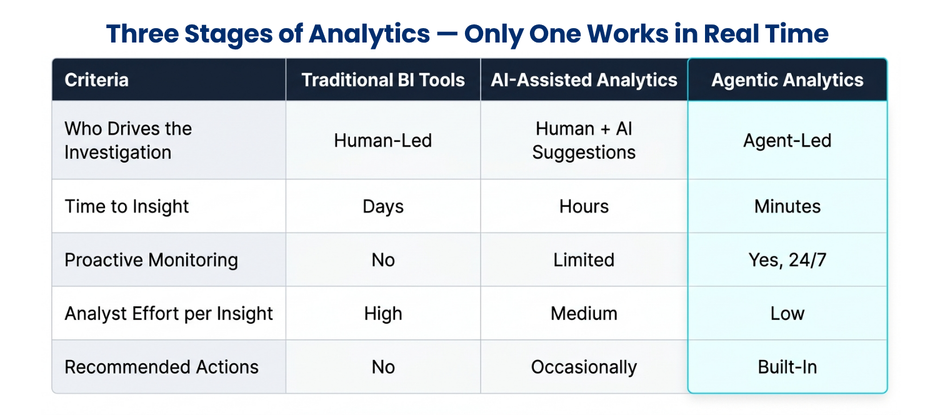
Conventional business intelligence (BI) technologies were designed for reporting purposes. They mostly rely on human labor, with analysts gathering data, creating dashboards, and analyzing findings. They are slow and backward-looking by nature, notwithstanding their usefulness.
AI-assisted analytics improved this by introducing features like auto-generated queries and visualizations. But the workflow still depended on humans to initiate and guide the process.
Agentic analytics changes the equation entirely. AI agents independently monitor, analyze, and report—while humans focus on decision-making. The difference isn’t incremental; it’s a complete shift in how teams interact with data.
How AI Agents Work
Under the hood, AI agents follow a structured but flexible process:
Goal Interpretation: They begin by understanding the objective or trigger—such as a sudden drop in sales.
Dynamic Planning: Instead of following fixed rules, they break the problem into smaller steps and adapt as needed.
Data Retrieval: Agents pull relevant data directly from connected systems—databases, APIs, or warehouses.
Self-Validation: Before sharing results, they cross-check findings to ensure consistency and accuracy.
Actionable Output: The final output includes insights, root causes, supporting data, confidence levels, and recommended actions.
This end-to-end capability is what makes them powerful—they don’t just analyze data; they close the loop.
Where They’re Delivering Value
AI agents are already driving measurable impact across several areas:
Real-Time Monitoring: Continuous tracking of key metrics helps teams catch issues early.
Fraud and Compliance: Agents can process large volumes of documents and flag risks proactively.
Self-Service Analytics: Business users can access insights without relying on data teams.
Automated Reporting: Reports are generated and delivered without manual effort.
Predictive Insights: Agents move beyond explanation to forecasting and recommendation.
These use cases highlight a broader trend—analytics is shifting from descriptive to proactive and predictive.
What You Must Do Correctly
Despite the promise, a few crucial elements are necessary for a successful deployment:
Data Quality: Any supplied data is amplified by AI bots. Poor data produces poor insights more quickly.
Security and Governance: Strict authorization controls and audit procedures are crucial when having access to several systems.
Explainability: Users must have faith in the results. Adoption depends on verifiable data sources and transparent reasoning.
One consistent pattern among successful teams is starting small. Instead of attempting a full transformation, they focus on a specific use case—prove value, build trust, and expand تدريجيًا.
The Final Score
AI data analysis bots are becoming commonplace rather than experimental. Adopting them helps organizations make better decisions, move more quickly, and bridge the gap between data and action.
The change is about getting rid of bottlenecks rather than replacing analysts. Teams can concentrate on what really matters—making timely, well-informed decisions—when routine analysis is automated.
Having data is not the true competitive edge in 2026; rather, it is the speed and efficiency with which you can use it. AI agents are making that possible.
Source: https://www.anavcloudsanalytics.ai/blog/ai-agents-for-data-analysis/
voters
Report Story 
Related Stories











Recent Stories