 AnavClouds Software Solutions
5 hours ago in Business Services
AnavClouds Software Solutions
5 hours ago in Business Services
Sosial Bookmarking Side med Høy Autoritet for Norsk SEO i 2026 - A2Bookmarks Norge
A2Bookmarks Norge er den ledende social bookmarking site i Norge, skreddersydd for norske brukeres behov. Denne sosiale bookmarking site for Norge lar deg enkelt lagre, organisere og dele dine favoritt-nettsteder og lenker med et brukervennlig grensesnitt. Enten du er en bedrift som ønsker å øke din online synlighet i det norske markedet, eller en privatperson som søker en bedre måte å administrere dine viktigste nettesider på, tilbyr A2Bookmarks de verktøyene du trenger. Øk autoriteten til din nettside og forbedre søkemotoroptimaliseringen din ved å bygge relevante tilbakekoblinger gjennom vårt norske bookmarking-nettverk. Som en av de beste norske social bookmarking sites for 2026, inviterer vi deg til å bli med i det voksende fellesskapet, oppdage nyttig innhold fra hele Norge, og forsterke din digitale tilstedeværelse med Norges fremste plattform for sosiale bokmerker. Utforsk de viktigste social bookmarking sites i det norske markedet for optimal SEO-ytelse.
Timeline for Salesforce Implementation: How Much Time Does It Actually Take? anavcloudsoftwares.com
AnavClouds Software Solutions
5 hours ago in Business Services
One straightforward question that arises when companies assess Salesforce is: How long will installation take? To be honest, it depends. While some businesses go live in a few weeks, others require several months. The key factors that determine the difference are scope, complexity, and team readiness prior to the start of the project.
Why Timelines Vary
There’s no universal Salesforce implementation timeline because no two businesses are the same. Compared to an enterprise that rolls out various clouds across geographies, a startup that implements a basic CRM setup will move considerably more quickly. The length of time can be greatly impacted by elements including data quality, integrations, and customization.
As a general benchmark:
Small businesses (SMBs): 4–8 weeks
Mid-sized companies: 2–4 months
Enterprises: 6–12 months or more
These are guidelines—not guarantees. The real timeline depends on a few critical drivers.
Key Factors That Impact Implementation Time
1. Scope and Cloud Selection
It is far faster to implement a single cloud, like Sales Cloud, than to deploy several solutions, like Sales, Service, and Marketing Cloud. Usually, a phased rollout is the most effective; begin with essential features and add more later.
2. Level of Customization
Salesforce offers powerful out-of-the-box features, but customization adds time:
Light customization: a few days to weeks
Moderate customization: several weeks
Advanced development (Apex, integrations): months
Keeping Phase 1 simple is one of the most effective ways to stay on schedule.
3. Data Migration Complexity
Data migration is often underestimated. Clean, well-structured data can be moved quickly, while messy or duplicate-heavy data can delay projects significantly. Starting data cleanup early is critical.
4. Integrations
Connecting Salesforce with tools like ERPs, marketing platforms, or support systems adds complexity. Standard integrations are faster, but custom APIs can extend timelines.
5. Adoption and Team Readiness
Without user adoption, even the best configuration fails. Timeliness and success are directly impacted by internal ownership, stakeholder alignment, and training.
The Process of Implementing Salesforce
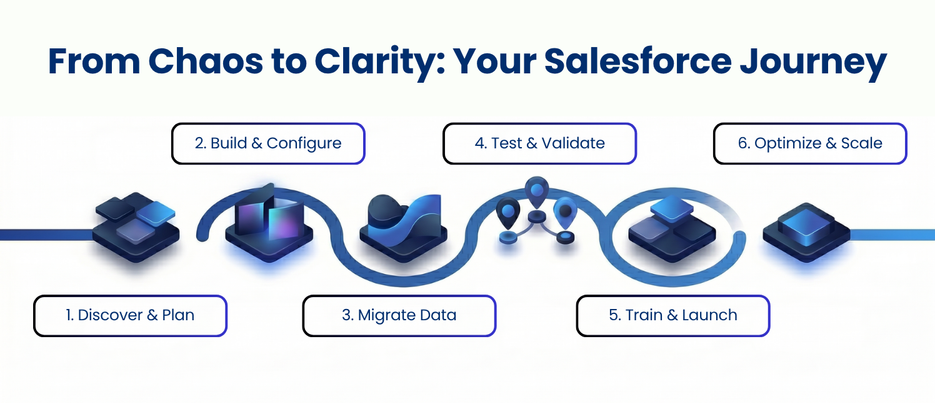
Six steps are usually involved in an organized implementation:
Planning and Discovery (2–6 weeks)
This stage establishes objectives, procedures, data strategy, and integrations. It’s the cornerstone, and hurrying it frequently causes delays down the road.
Development and Configuration (4–16 weeks)
In this case, the system is constructed in a sandbox setting. It involves configuring reports, developing automation, making custom objects, and setting up users.
Data Migration (two to six weeks)
This stage, which frequently coincides with development, entails data cleaning, mapping, and transfer into Salesforce.
Testing (one to three weeks)
Extensive testing guarantees that everything functions as planned. Post-launch problems are nearly usually the result of skipping this step.
Training & Go-Live (1–2 weeks)
Users are trained based on their roles, followed by deployment and initial support (often called “hypercare”).
Post-Implementation Optimization (Ongoing)
After go-live, continuous improvements help maximize ROI through feedback and feature enhancements.
Common Challenges That Delay Projects
Even well-planned implementations face obstacles. The most common include:
Scope creep: Expanding requirements mid-project
Poor data quality: Slowing migration and reducing trust
Lack of leadership involvement: Delaying decisions
Insufficient training: Weak adoption
Rushed testing: Leading to costly fixes later
Addressing these early can save weeks—or even months.
How to Speed Up Implementation (Without Cutting Corners)
If you want to accelerate your Salesforce implementation timeline, focus on efficiency—not shortcuts:
Use standard features before building custom solutions
Start data cleanup during the discovery phase
Prioritize high-impact features first
Keep stakeholders available for quick decisions
Work with experienced implementation partners
Concluding Remarks
Going properly is more important for a successful Salesforce implementation than moving quickly. The essentials are the same whether your schedule is a few weeks or several months: user adoption, clear goals, clean data, and effective planning.
When used effectively, Salesforce transforms from a CRM into a solution that propels actual business expansion.
Source: https://www.anavcloudsoftwares.com/blog/salesforce-implementation-timeline/
Report Story
Related Stories










Recent Stories