 AnavClouds Analytics.ai
1 day ago in Business Services
AnavClouds Analytics.ai
1 day ago in Business Services
Sosial Bookmarking Side med Høy Autoritet for Norsk SEO i 2026 - A2Bookmarks Norge
A2Bookmarks Norge er den ledende social bookmarking site i Norge, skreddersydd for norske brukeres behov. Denne sosiale bookmarking site for Norge lar deg enkelt lagre, organisere og dele dine favoritt-nettsteder og lenker med et brukervennlig grensesnitt. Enten du er en bedrift som ønsker å øke din online synlighet i det norske markedet, eller en privatperson som søker en bedre måte å administrere dine viktigste nettesider på, tilbyr A2Bookmarks de verktøyene du trenger. Øk autoriteten til din nettside og forbedre søkemotoroptimaliseringen din ved å bygge relevante tilbakekoblinger gjennom vårt norske bookmarking-nettverk. Som en av de beste norske social bookmarking sites for 2026, inviterer vi deg til å bli med i det voksende fellesskapet, oppdage nyttig innhold fra hele Norge, og forsterke din digitale tilstedeværelse med Norges fremste plattform for sosiale bokmerker. Utforsk de viktigste social bookmarking sites i det norske markedet for optimal SEO-ytelse.
Self-Service BI Strategy: An Intelligent Approach to Business Decision-Making anavcloudsanalytics.ai
AnavClouds Analytics.ai
1 day ago in Business Services
Nowadays, the majority of businesses are famished for insights while drowning in data. A marketing manager requests a report from IT, waits a few days, and by the time the report is received, there is already no time to take action. Self-service BI is specifically intended to address this issue.
Without relying on IT personnel for each report, non-technical users can access, analyze, and visualize data using self-service business intelligence (BI). Teams may examine data on their own and make quicker, better decisions rather than waiting days for answers.
Self-service BI is becoming increasingly popular as businesses seek improved collaboration, faster access to information, and more robust data-driven cultures. Businesses are coming to the realization that data shouldn’t be restricted to technical divisions. The people who make daily company choices should have access to it.
Why Is Self-Service BI Important?
Bottlenecks are frequently produced by conventional BI systems. Decision-making is slowed down by the IT or data teams handling each reporting request. By providing departments with direct access to dashboards, reports, and analytics tools, self-service BI eliminates this reliance.
The user-friendly interfaces of contemporary self-service BI solutions include visual exploration, drag-and-drop dashboards, and natural language queries. Workers without technical expertise may create reports and identify trends with ease.
Giving everyone access to dashboards is not enough for self-service BI to be successful, though. Strong governance, accurate data, and appropriate training are also necessary. Businesses run the risk of producing inconsistent reports and untrustworthy insights without these underpinnings.
Developing an Effective Self-Service BI Approach
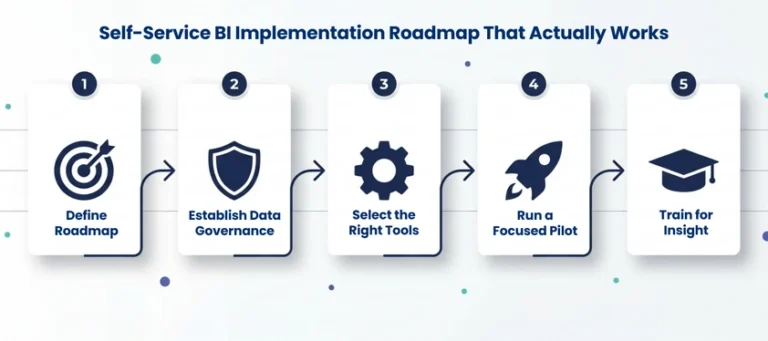
Clear business objectives are the foundation of every successful self-service BI approach. Businesses should determine which teams require improved data access, where reporting delays occur, and which decisions could be improved with real-time insights.
Governance is the next stage. Before expanding self-service analytics across departments, organizations must create role-based access, standardize metrics, and guarantee data quality. A “single source of truth” established by governance ensures that reports are reliable and consistent.
Choosing the right BI platform is equally important. Tools like Microsoft Power BI, Tableau, and Qlik Sense are popular because they combine ease of use with strong data integration and visualization capabilities.
Instead of launching organization-wide immediately, businesses should begin with a focused pilot project. Starting with one department allows teams to identify issues, refine processes, and build confidence before scaling further.
Common Challenges Businesses Face
Many self-service BI initiatives fail because companies overlook adoption and training. Simply providing access to a tool does not guarantee employees will use it effectively.
Data silos are another common issue. When departments use disconnected systems, reports often produce conflicting numbers. Integrating data into a unified environment is essential for accurate analytics.
Low-quality data can also undermine the entire initiative. Even the most advanced BI platform cannot generate meaningful insights from incomplete or inconsistent information. Businesses need reliable data management practices from the beginning.
How AI Is Transforming Self-Service BI
Artificial intelligence is making self-service BI even more powerful. Modern BI platforms now support natural language queries, allowing users to ask questions like, “Which region had the highest sales growth last quarter?” and instantly receive visual insights.
AI-driven analytics can also detect anomalies, predict trends, and automatically generate insights without requiring advanced technical skills. This is helping organizations move beyond simple reporting toward proactive, data-driven decision-making.
Conclusion
Self-service BI is now a strategy for business transformation rather than only a reporting tool. Businesses may enable every department to make quicker and more intelligent decisions by combining accessible analytics with robust governance, high-quality data, and user training.
Self-service BI will play a crucial role in contemporary enterprise strategy as companies continue to use AI-powered analytics and real-time insights. Businesses will develop a more robust and flexible decision-making culture in the future if they invest in the appropriate roadmap now.
Source: https://www.anavcloudsanalytics.ai/blog/self-service-bi-strategy/
voters
Report Story 
Related Stories


Recent Stories