 AnavClouds Analytics.ai
5 hours ago in Business Services
AnavClouds Analytics.ai
5 hours ago in Business Services
Sosial Bookmarking Side med Høy Autoritet for Norsk SEO i 2026 - A2Bookmarks Norge
A2Bookmarks Norge er den ledende social bookmarking site i Norge, skreddersydd for norske brukeres behov. Denne sosiale bookmarking site for Norge lar deg enkelt lagre, organisere og dele dine favoritt-nettsteder og lenker med et brukervennlig grensesnitt. Enten du er en bedrift som ønsker å øke din online synlighet i det norske markedet, eller en privatperson som søker en bedre måte å administrere dine viktigste nettesider på, tilbyr A2Bookmarks de verktøyene du trenger. Øk autoriteten til din nettside og forbedre søkemotoroptimaliseringen din ved å bygge relevante tilbakekoblinger gjennom vårt norske bookmarking-nettverk. Som en av de beste norske social bookmarking sites for 2026, inviterer vi deg til å bli med i det voksende fellesskapet, oppdage nyttig innhold fra hele Norge, og forsterke din digitale tilstedeværelse med Norges fremste plattform for sosiale bokmerker. Utforsk de viktigste social bookmarking sites i det norske markedet for optimal SEO-ytelse.
Snowflake vs Databricks: Which Data Platform Fits Your Business Best? anavcloudsanalytics.ai
AnavClouds Analytics.ai
5 hours ago in Business Services
As businesses continue to invest heavily in cloud and AI technologies, choosing the right data platform has become a critical decision. Among the most discussed comparisons today is Snowflake vs Databricks. Both platforms are powerful, scalable, and enterprise-ready — but they are designed for very different purposes.
Understanding their strengths can help organizations avoid costly mistakes and build a smarter long-term data strategy.
Understanding the Core Difference
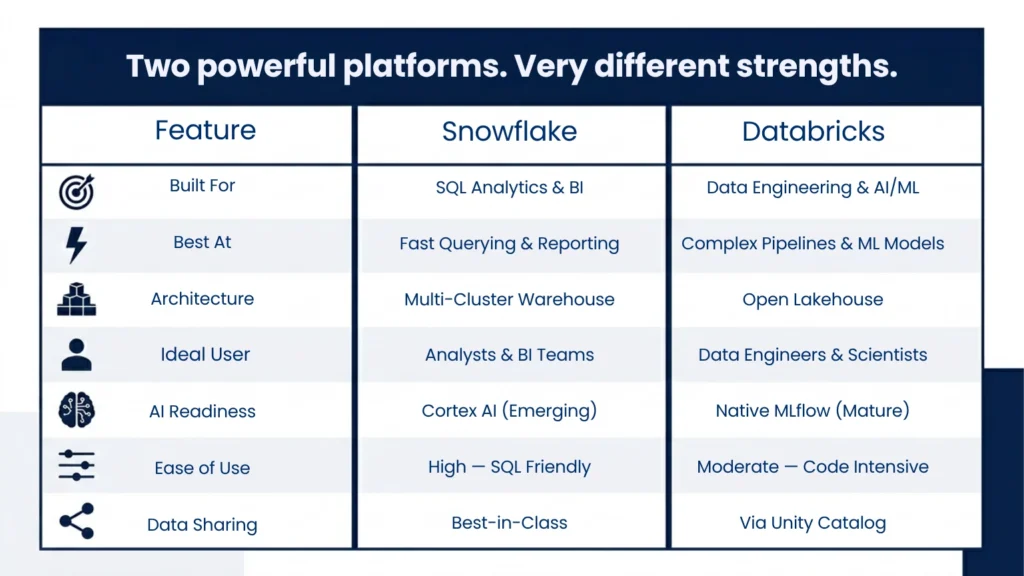
At a high level, Snowflake is a cloud-native data warehouse built primarily for analytics and business intelligence. It is known for its simplicity, fast SQL performance, and secure data sharing capabilities. Businesses that rely heavily on dashboards, reporting, and structured analytics often prefer Snowflake because it allows teams to scale compute and storage independently while maintaining high query performance.
Databricks, on the other hand, was built around Apache Spark and focuses on data engineering, machine learning, and AI workloads. It introduced the “lakehouse” architecture, combining the flexibility of data lakes with the reliability of data warehouses. Databricks is ideal for organizations handling large-scale ETL processes, streaming data, and advanced AI development.
In short:
-
Snowflake is optimized for analytics and BI.
-
Databricks is optimized for engineering, AI, and machine learning.
Architecture and Performance
One of the biggest differences in the Snowflake vs Databricks debate is architecture.
Snowflake separates storage and compute completely, making it easy to scale workloads independently. This design helps multiple teams run analytics simultaneously without performance slowdowns. It works especially well for enterprises focused on reporting and business intelligence transformation.
Databricks uses Delta Lake and Spark-based processing to manage massive volumes of structured and unstructured data. Its architecture is designed for flexibility and large-scale processing rather than pure SQL analytics.
Performance also depends on the workload:
Snowflake performs best for:
-
SQL analytics and reporting
-
High-concurrency dashboards
-
Real-time business intelligence
-
Secure cross-team data sharing
Databricks performs best for:
-
Large ETL pipelines
-
Machine learning workflows
-
Streaming analytics
-
AI model development and deployment
This is why many modern enterprises use both platforms together rather than choosing only one.
Choosing the Right Platform
The right choice depends entirely on business goals.
Choose Snowflake if your business needs:
-
Fast and reliable analytics dashboards
-
Easy-to-manage cloud data warehousing
-
Secure data sharing across departments
-
Minimal infrastructure management
-
Strong SQL-focused workflows
Choose Databricks if your business needs:
-
Advanced machine learning solutions
-
Complex data engineering services
-
AI development at scale
-
Processing of unstructured or streaming data
-
Custom predictive analytics pipelines
For organizations investing in both analytics and AI, combining Snowflake and Databricks can create a powerful modern data ecosystem.
Pricing Considerations
Both platforms use consumption-based pricing models, but costs can vary significantly depending on workloads.
Snowflake charges based on virtual warehouse usage and storage separately. While simple to understand, costs can rise quickly with heavy concurrent query workloads.
Databricks charges through Databricks Units (DBUs), and pricing depends on cluster configurations and compute resources. Improperly managed clusters can lead to unexpected cloud expenses.
Because of this, cost optimization and workload planning are essential for both platforms.
Final Thoughts
The Snowflake vs Databricks debate does not have a universal winner because both platforms solve different problems exceptionally well.
Snowflake remains one of the best solutions for cloud analytics, business intelligence reporting, and governed data sharing. Databricks excels in large-scale data engineering, machine learning solutions, and enterprise AI workloads.
The smartest organizations are not asking which platform is “better.” Instead, they are asking which platform is better suited for each workload.
As businesses continue building AI-driven strategies, selecting the right data platform — or combination of platforms — can directly impact scalability, innovation, and long-term success.
Source: https://www.anavcloudsanalytics.ai/blog/snowflake-vs-databricks-pick-the-right-data-platform/
voters
Report Story 
Related Stories





Recent Stories